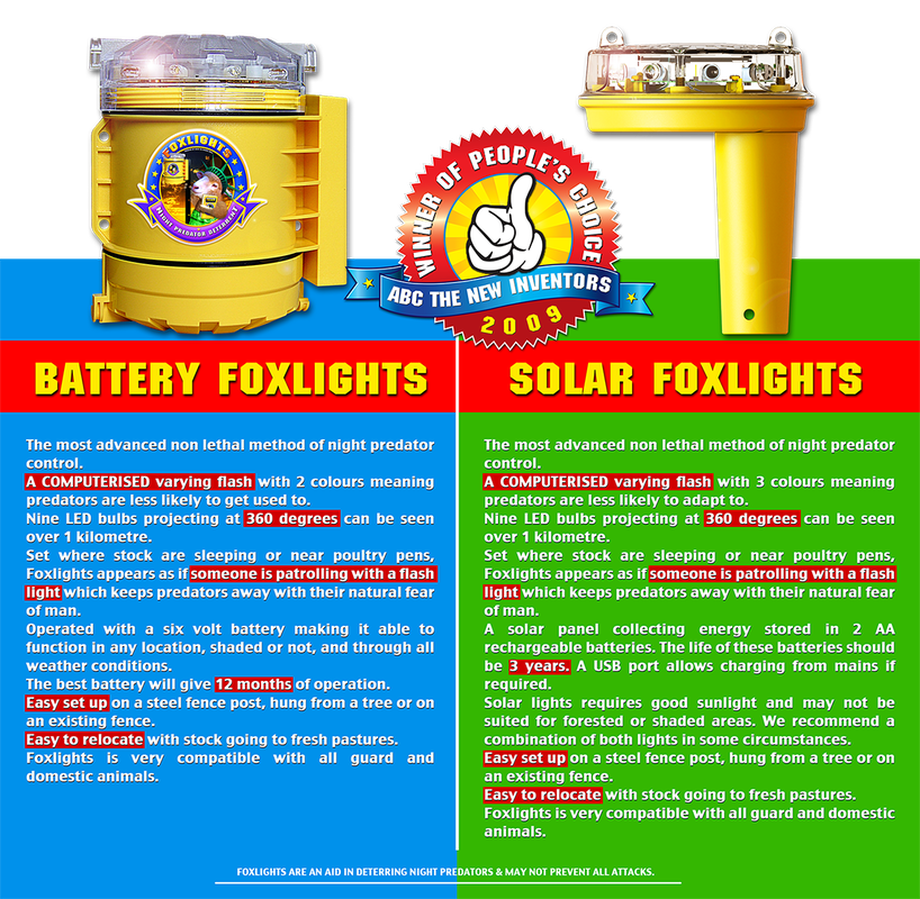
The way to protect your vulnerable animals from attacks by foxes and other night predators.
THE FOXLIGHTS
The principle behind the flashing light is that a fox thinks there is a person present when and where they see the flash. The flash is designed in such a way so as to appear irregular and repositioned. Foxlights are powered by a standard 6volt torch battery ( Eveready 1209 or similar ) ( battery not included ), and should give flashes for between 4 and 6 months. A light sensor will trigger flashing in conjunction with sunrise and sunset. When the battery runs out of power the light will slowly fade rather then just stop flashing.
Winner of the Home Viewers Contest on the ABC's "The New Inventors" 12th August 2009.
Presented on :
"ABC's "The New Inventors" 12th August 2009.
"ABC's Country Hour" 27th August 2009.
"Radio Australia Innovations" 28th SEP 2009.
LAMBS OR KIDS
Most fox attacks will occur within the first 24 hours of an animals' life.
Twins are the most at risk. while the second lamb or kid is being born, the first born will wander off bleating and unprotected thus primed for attack.
Lights are best concentrated around camp sites. Set up on the crest of hills they should give protection over a large area.
The Australia national cost of fox predation on lambs alone is estimated to be between 100 and 200 million dollars.
POULTRY
In the case of free range poultry, one light set near roosting pens should keep foxes away at night. If the fox doesn’t visit the hen house while hens are shut up then it is less likely to wait for or return the next morning to attack when the hens come out to feed.
When ducks or geese camp on or near farm dams they are most vulnerable to foxes, but a Foxlight set up near their camp should give them protection.
ENDANGERED WILDLIFE
It is our belief that Foxlights will give protection against fox and wild dog attacks to small ground dwelling species.
Lights should be set on the perimeters of rookeries or night habitat areas.
People are at present testing the effects of Foxlights in conserving endangered wildlife.
For contact and more information please continue to page 2